Championship Wrestling Federation
Mobile Trading Card Game
Here’s a story…
The Challenge
Our client wanted to develop a digital trading card game that is a love letter to professional wrestling.
Draw on my 20+ year, all-consuming obsession and design the entire game from the ground up.
My Role
From 2010 - 2016, I was a professional wrestler. I trained with WWE, WCW, and ECW legend Lance Storm and during those years, I wrestled and toured on the independent wrestling scene in Canada. Wrestling has been my obsession since I was five years old, and the confluence of this passion and experience was that I was able to offer an insider’s perspective that stood head and shoulders above the average fan.
I have always, and will always, choose to gamble on myself. I convinced our client to let me design the entire game from the ground up, from mechanics to merchandise.
It also helped my case that I had been heavily involved in trading card game communities for over twenty years at this point.
What!?
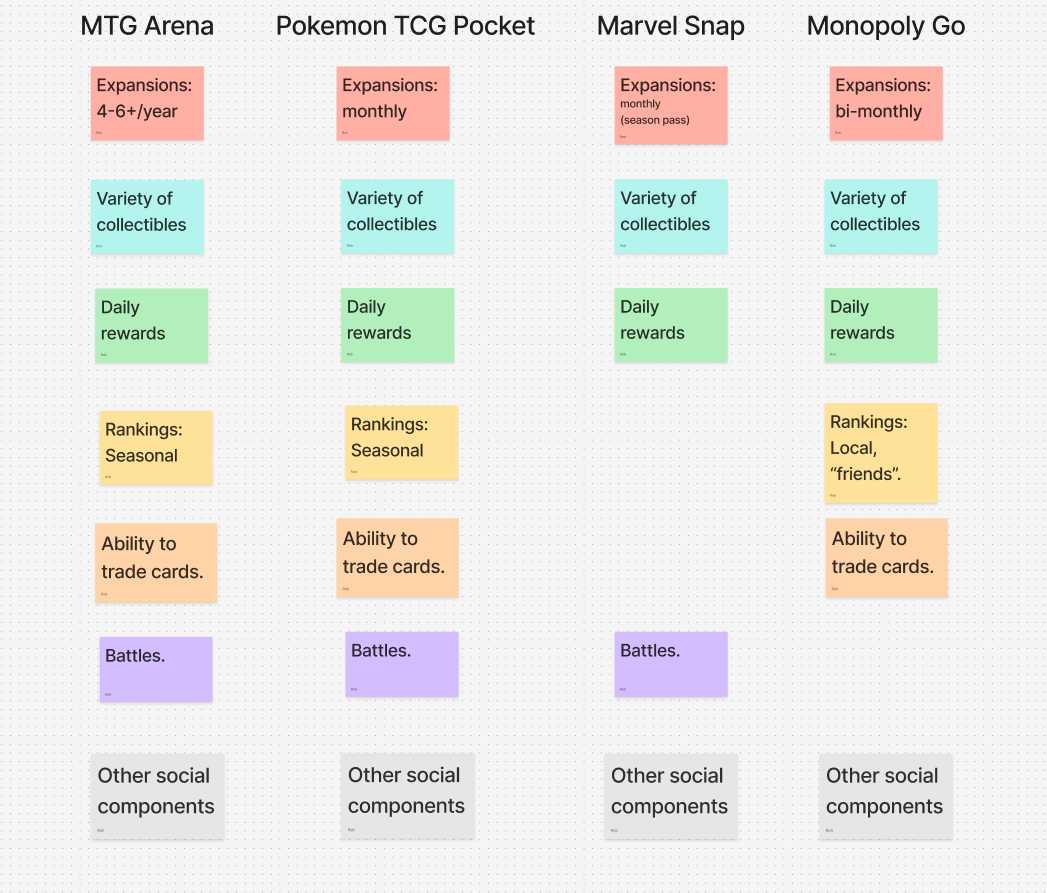
The first step was the most fun competitive audit I’ve ever done. I surveyed several of the most popular digital TCGs on the market and broke them down into core components. I wanted to identify the common factors that make these games fun, functional, and maintain such loyal fanbases across decades.
Games surveyed included:
Marvel Snap
Pokemon TCG Pocket
Magic: The Gathering Arena
*Bonus: Monopoly Go
Monopoly Go isn’t a trading card game, but it does have a card collecting component. It is also a massively popular mobile game with a very active fanbase, and an outside point of reference never hurts.
Getting Started
All of these games come from well established IPs with long histories and generations of fans. Pokemon’s popularity rose in the late 90s, MTG in the early 90s, Monopoly in the 70s and 80s, and Marvel has been in the public sphere since the 1940s (by various names).
Professional wrestling is a double edged-sword because it has been a popular form of entertainment since the 1930s, with notable boom periods in the 1960s, 1980s, 1990s, and now in the 2020s. The problem is that, after purchasing its competition in 2001, WWF/WWE held a monopoly on the American market until the emergence of AEW as a viable competitor in 2019.
Subsequently, WWE has become the go-to point of reference and catch-all term for all things wrestling, in the same way it is common to call a tissue a Kleenex or a cotton swab a Q-Tip. The brand loyalty that has emerged from fans of professional wrestling and WWE’s market control means that we have to tow a fine line between homage and parody, since we are working without licensed characters.
Early Thoughts….
The Core Components
I began the audit by asking a set of basic questions;
If I am a user…
Why do I want to play this game?
What makes me want to log in and play this game every day?
What keeps me hooked?
What will make me want to spend money?
It took only a few minutes of playtime in each game to find the answers.
Play:
Battle
Trading
Collecting
Findings could be broken down into three "driver” categories.
Marketing and revenue drivers:
Card distribution (expansion sets, scheduled releases)
Collectibles
I now had a good idea of the ‘why’s’; why people play, why people log in daily, and why people spend money on free-to-play games.
Since it was my task to design the overall play system with recommendations for marketing, it was time to start assembling the game mechanics.
Use Drivers:
Daily rewards
Collectability
Social (friends lists)
Preparing for Battle
The first step was designing the battle system. Complex battle systems can be alienating, so for the first release it made sense to keep it simple and familiar.
The point of the game is to replicate a wrestling match. Wrestling matches have five parts:
The Shine (we meet the characters, learn who is the babyface (hero) and heel (villain), and why)
The Cutoff (The heel gets the upper hand).
The Heat (the heel is in control, sympathy builds for the babyface)
The Comeback (the babyface rallies)
The Finish (the conclusion of the match).
**(Note that this is also the structure of basically every movie, tv show, and story ever written)
Gameplay cannot follow this structure exactly, but we can get pretty close.
First, I needed to determine the types of cards.
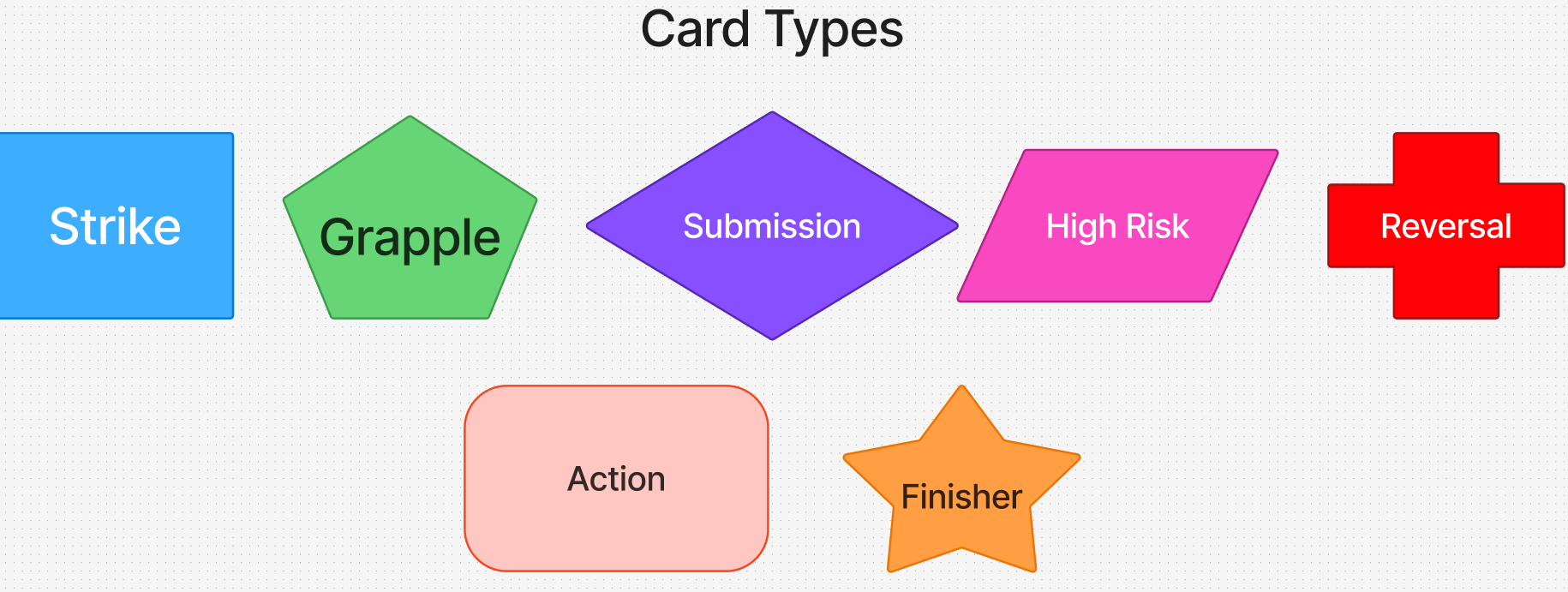
Since we are replicating a wrestling match, the initial card types would be categories of moves. I was able to identify five broad categories of move types, plus ‘Finishers’. A finisher is a professional wrestler’s signature move, the one you would use repeatedly on your friends as a kid.
There are also action cards which would provide a stipulation or condition with short and medium-term effects.
The cards were colour coded so they could be easily recognised. I floated the idea of using unique shapes featured prominently somewhere on the card, but after discussions with the client, we ultimately agreed that standard shapes just didn’t look good. We agreed to revisit the subject later in development out of respect for colour-blindness.
Next was determining the structure of play.
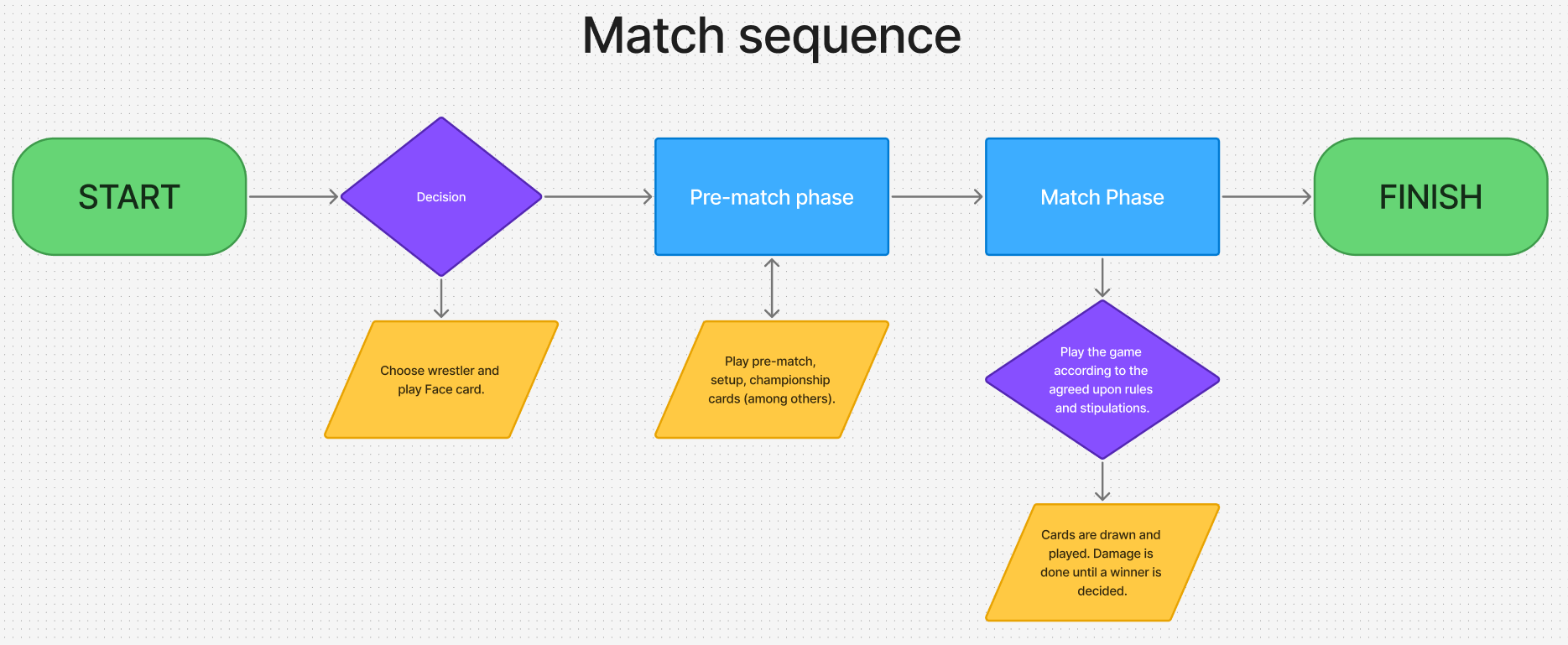
The pre-match phase would be used to establish any unique conditions or mechanics of the match, while the bulk of play takes place during the match phase. Analogically, the pre-match phase is functionally the Shine, while the rest of the structure is carried out in the Match phase.
It is optional, but players can use the pre-match/setup phase to copy some of the more iconic entrances in wrestling history using music and elaborate dress if they so choose. I’m not here to judge.
We have our cards, we have our structure, now what are we going to do with it?
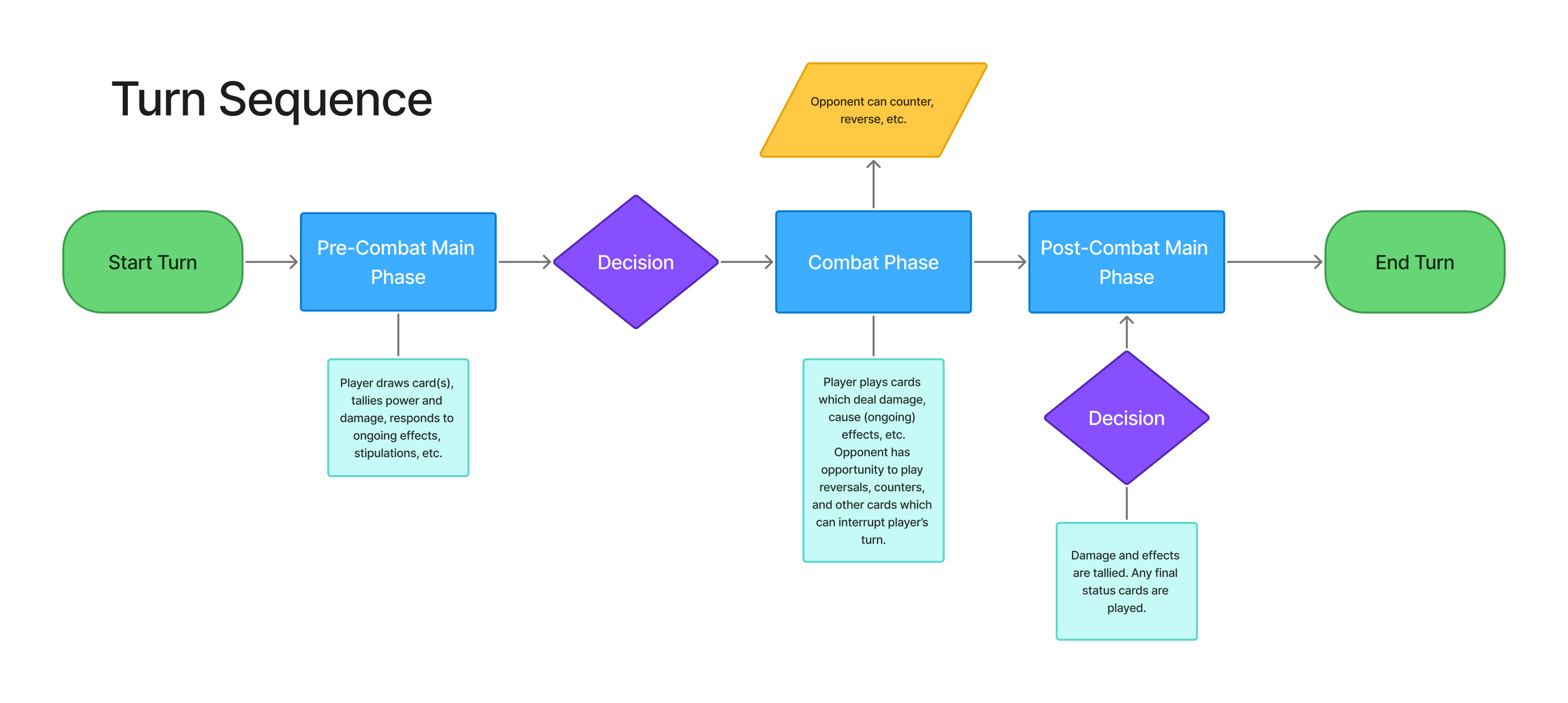
It’s time to play the game!
The basic rules are that each player will start with a 60-card deck consisting of an assortment of the aforementioned card types. The deck is represented by a superstar or ‘face’ card which represents a character. Each character has signature moves, including a ‘Finisher’, which create a unique play experience.
Players start by drawing the number of cards indicated by the character’s ‘Hand Size’, then use the ‘Star Power’ feature to determine who plays first. In the event of a tie, flip a coin.
Both players start with zero ‘Power’. Move cards will cost ‘Power’ to play (including cost of zero) and subsequently deal damage, which in turn gains the player more Power. Damage is taken by overturning cards from the player’s deck. The damaged player overturns cards until they reach the number of damage indicated by the card played, or until they overturn a reversal card that they have the Power to play.
A winner is determined when one player runs out of cards to overturn, or until the agreed upon win condition is met. There were discussions about introducing new win conditions in later expansions, but this was the basic binary win-loss structure.
It goes without saying, but I’m going to say it anyway; a collectible trading card game isn’t sustainable (or fun) without something to collect and trade.
Whether it is the satisfaction of completing a set, bragging rights from bagging an ultra rare, or just the thrill of the hunt, players need a reason to keep coming back to the game. Recurring influxes of new cards are critical to sustainability, but excessive releases will lead to oversaturation and collectors being overwhelmed.
As a player and collector myself, I like knowing that there is always something new and fresh around the corner, but I like to at least feel lit it’s possible that I will be able to collect an entire set.
Striking a balance between release frequency, variety, and familiarity are key to the sustained success of our game, so I looked at the release schedules of our competitors.
Keeping it Fresh and Telling a Story

Each of our competitors releases new cards quarterly at least, monthly at most. This is where things got very, very easy.
Professional wrestling is primarily about long-form storytelling. Stories are told through weekly television shows, building to major events (generally pay-per-view events, but lately called ‘Premium Live Events’ by WWE). The most satisfying stories have twists and turns that culminate in a moment at a major event.
For the last 30 years, every major professional wrestling promotion has had a yearly schedule of super cards where these stories reach their zenith. Being creatures of habit, professional wrestling fans are familiar with this schedule, looking forward to certain yearly spectacles and wanting something novel and fresh in between.
Subsequently, it was only a matter of morphing our release schedule into a super card schedule, mimicking the format fans have been familiar with for decades. Stories should be exciting and unpredictable. Event schedules can never be.
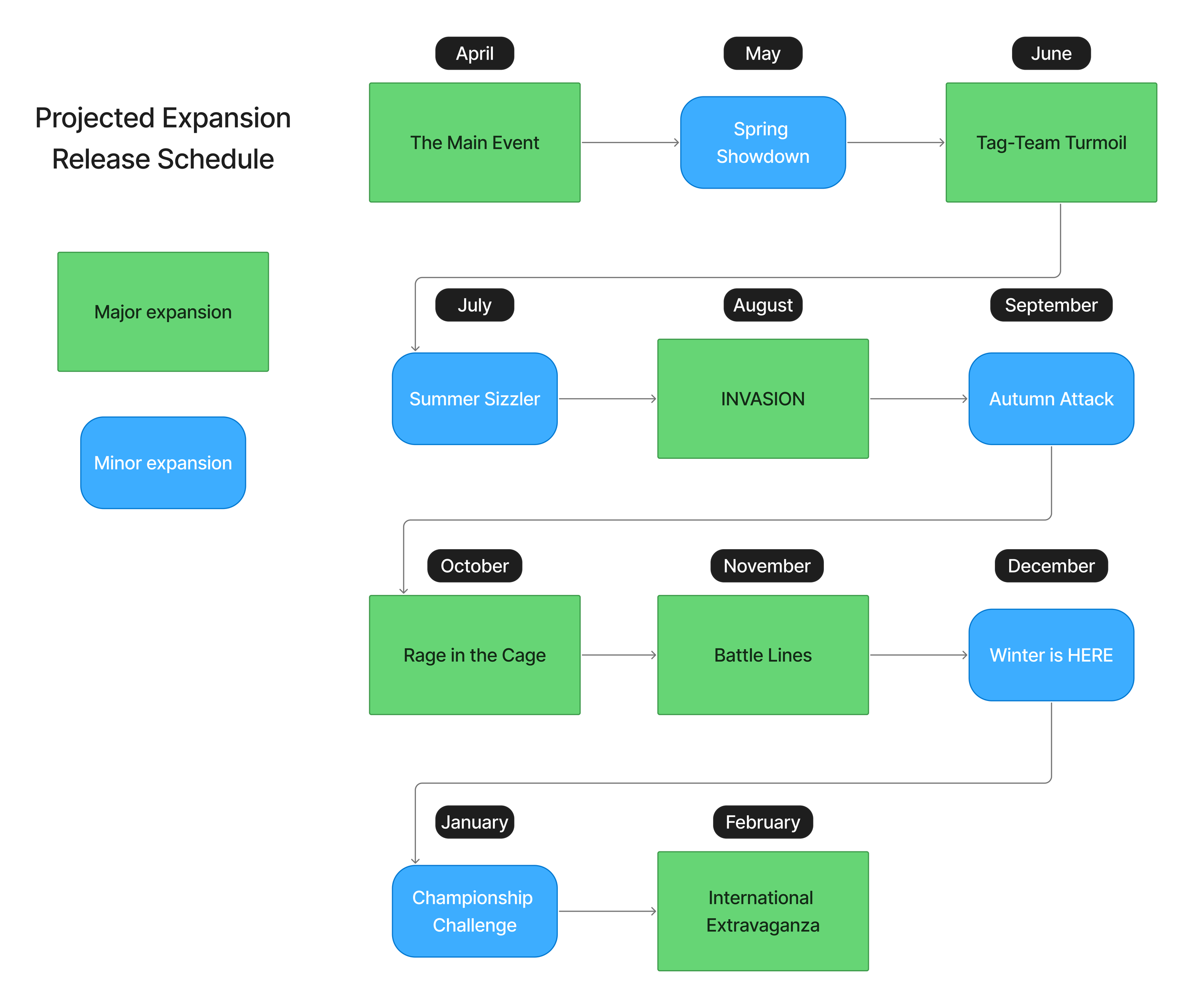
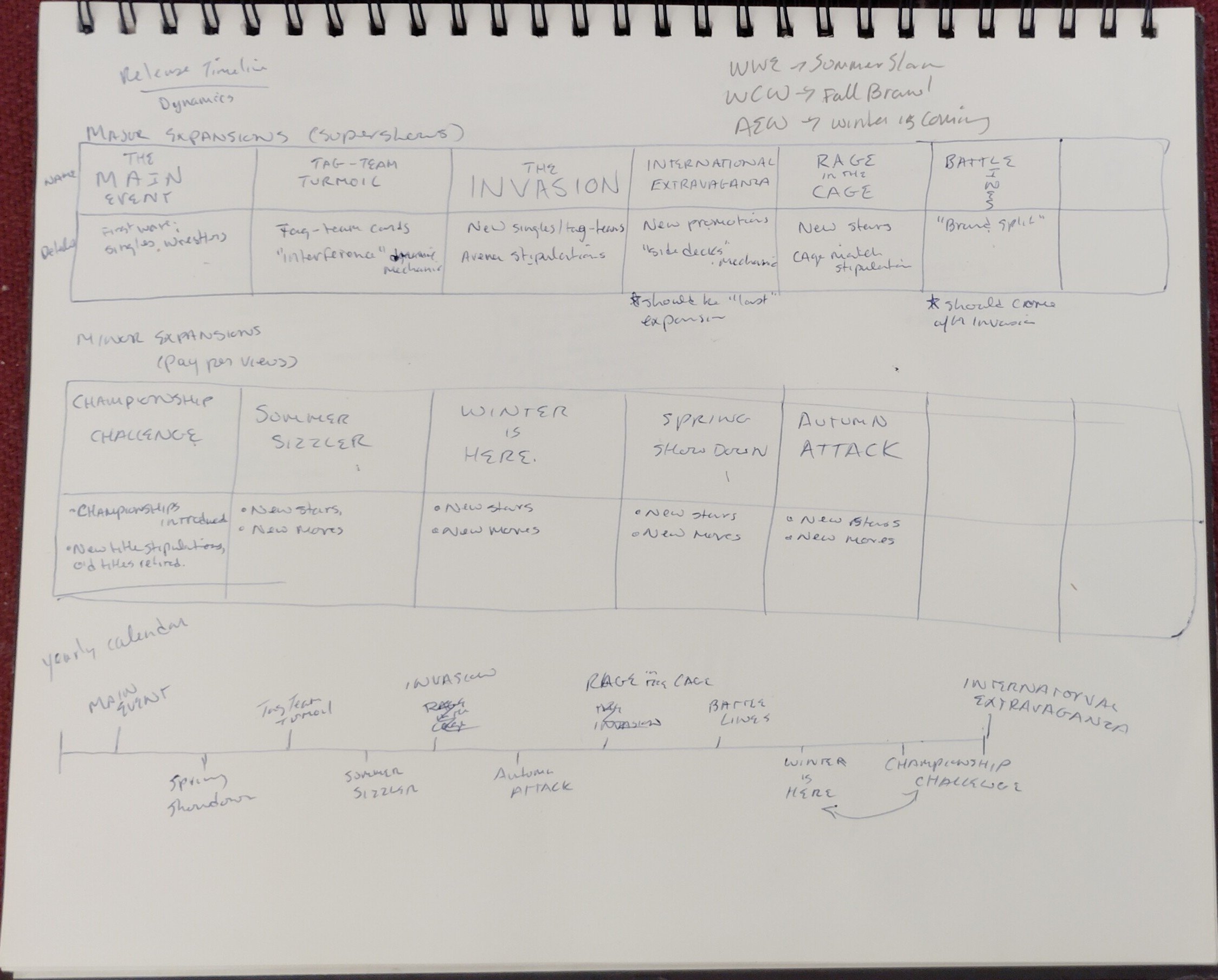
We agreed that expansions would be released as Major and Minor expansions, mimicking the practice of ‘A-shows’ (AEW All In, WWE WrestleMania) and ‘B-shows’ (AEW Revolution, WWE Wrestlepalooza).
Major expansions would serve to introduce new mechanics, match types, and other themes, while Minor expansions would primarily focus on new characters and other cards. Our launch title, The Main Event, coincides with WWE’s annual WreslteMania event, a major date for hardcore and casual fans alike.
I was particularly proud of the plan for the INVASION Major expansion and subsequent storyline, which is itself an allusion to WWF’s Invasion event from 2001. The plan was to introduce new ‘promotions’, expanding our universe with new characters, championships, venues, and a litany of new features. This would lead to a show-down at Rage in the Cage, the division of the characters at Battle Lines, and one final, major confrontation for team supremacy at International Extravaganza the following February (that this is near the end of the fiscal year is not a coincidence).
The titling of the minor expansions is a homage to various seasonally themed events from several major promotions. We referenced WCW’s Spring Stampede, WWE’s SummerSlam, and AEW’s Winter is Coming. I wanted to allude to WWE’s one-off Great Balls of Fire event, but couldn’t figure out how to make it work.
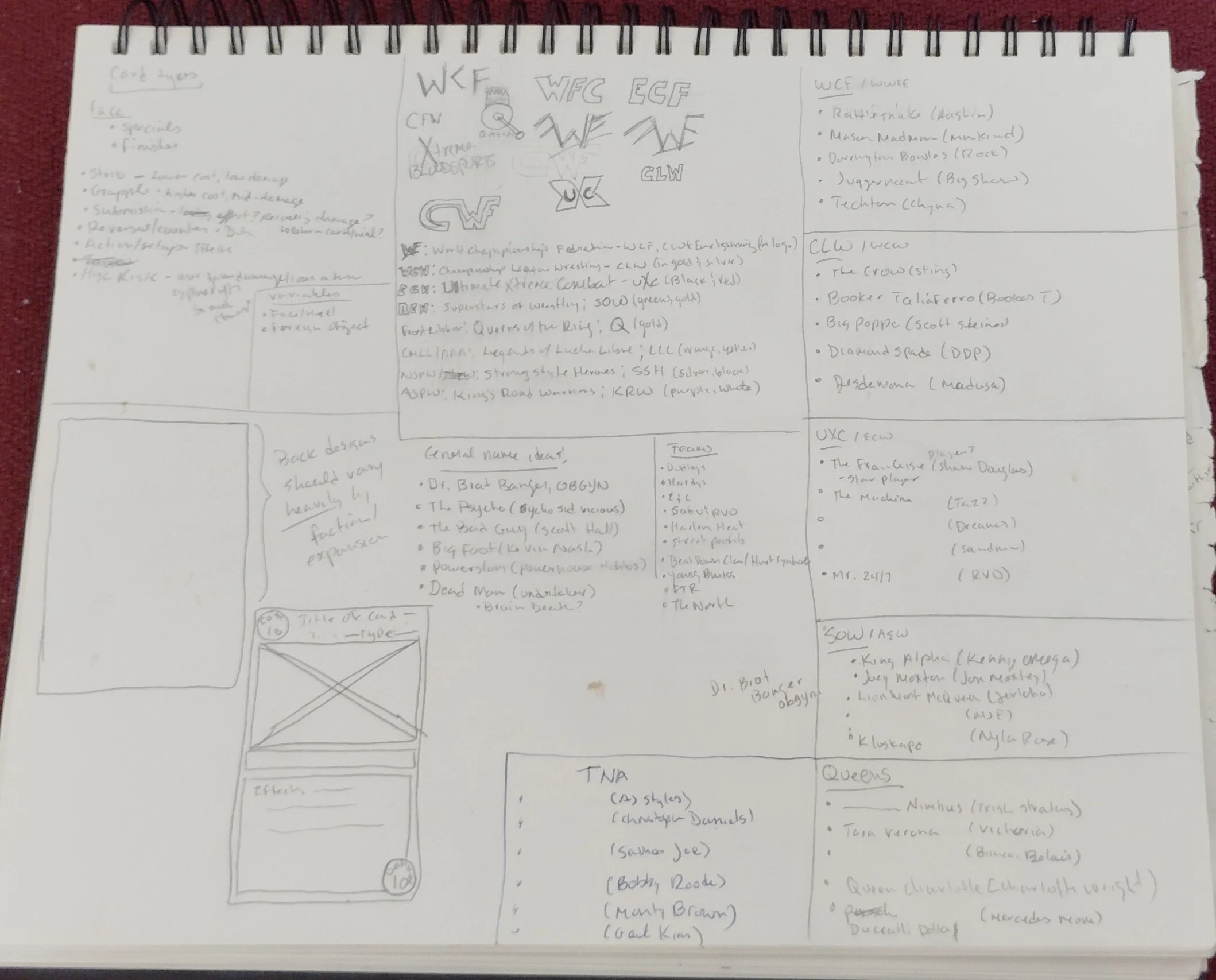
Early concepts for the Invasion Major expansion, including parody and reference names. Extreme Championship Wrestling is referenced as Ultimate Xtreme Wrestling, Kenny Omega is King Alpha, etc.
An early iteration of the expansion release schedule, indicating changes.
Money Matters
While the game was designed to be Free-to-play, we needed revenue drivers in order to make it a viable product. I am not a marketing expert, and I will not pretend to be. I am simply a life-long fan of two very specific things and possess a deep, practical, first-hand understanding of how to sell to those products to their respective audiences.
We identified three main categories for potential revenue.
Cards and related
Accessories (which will have an impact on gameplay)
Aesthetics (which will not have an impact on gameplay).
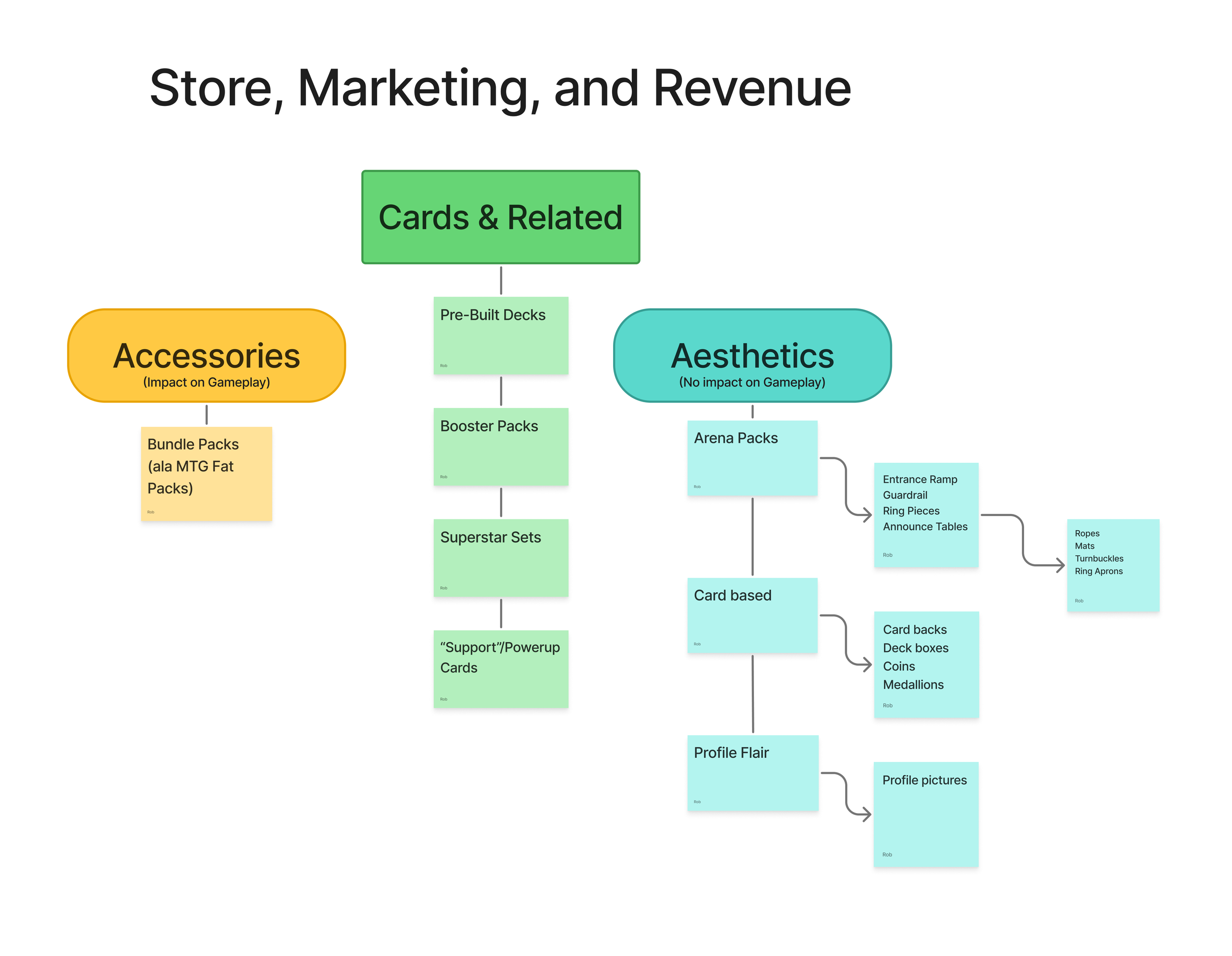
Most of the revenue drivers are standard fare to the point of being common sense. Besides basic things like profile flair, deck boxes and card covers, I suggested that we emphasise environmental aesthetics.
A professional wrestling show is meant to be an experience. Weekly tv shows and major events take place in different venues with unique aesthetics, like entrance sets and ring dressing. The ability to customise those details adds an extra layer for the player to make the game their own (and their inclusion is expected at this point).
With respect to cards, I suggested focusing on three specific products; pre-constructed decks, booster packs, and Star Sets.
Pre-constructed decks would contain 60 cards and be based around a single character (teams included later), with a superstar or "face’ card representing the character in question. The deck would also contain several character-specific cards representing unique moves or other characteristics. They would not contain the character’s finisher.
Booster packs were to be standard packs of move cards, but I suggested we should also feature unique characters and their specific moves that could not be found in pre-constructed decks. Likewise, finishers could only be found in booster packs, thus creating artificial scarcity and the need to acquire booster packs in order to complete a set.
Furthering the scarcity, some characters would be available as ‘Superstar Sets’. These would be sets of characters and their specific cards not available in either pre-constructed decks or booster cards. My idea was to use my contacts in the world of wrestling to negotiate licensing deals with independent wrestlers, who operate as independent contractors. We could license their likeness, thereby capitalising on existing name value and generate more appeal with existing fans.
This is not an unusual arrangement. Hundreds of independent wrestlers have licensing deals with digital storefronts, like Pro Wrestling Tees and Hot Topic.
Additionally, I was set on replicating the ‘fat packs’ from older Magic: The Gathering expansions. The Fat Pack typically contained 6-9 booster packs, unique deck boxes, card sleeves, and a few other collectibles for a reduced price, thereby offering a (debatably) affordable entry to the expansion. Pokemon has done something similar with their physical cards, so there is precedent for this product line as well.
Further, discussions were held about premium in-game currencies and monthly subscription models, including tier systems.
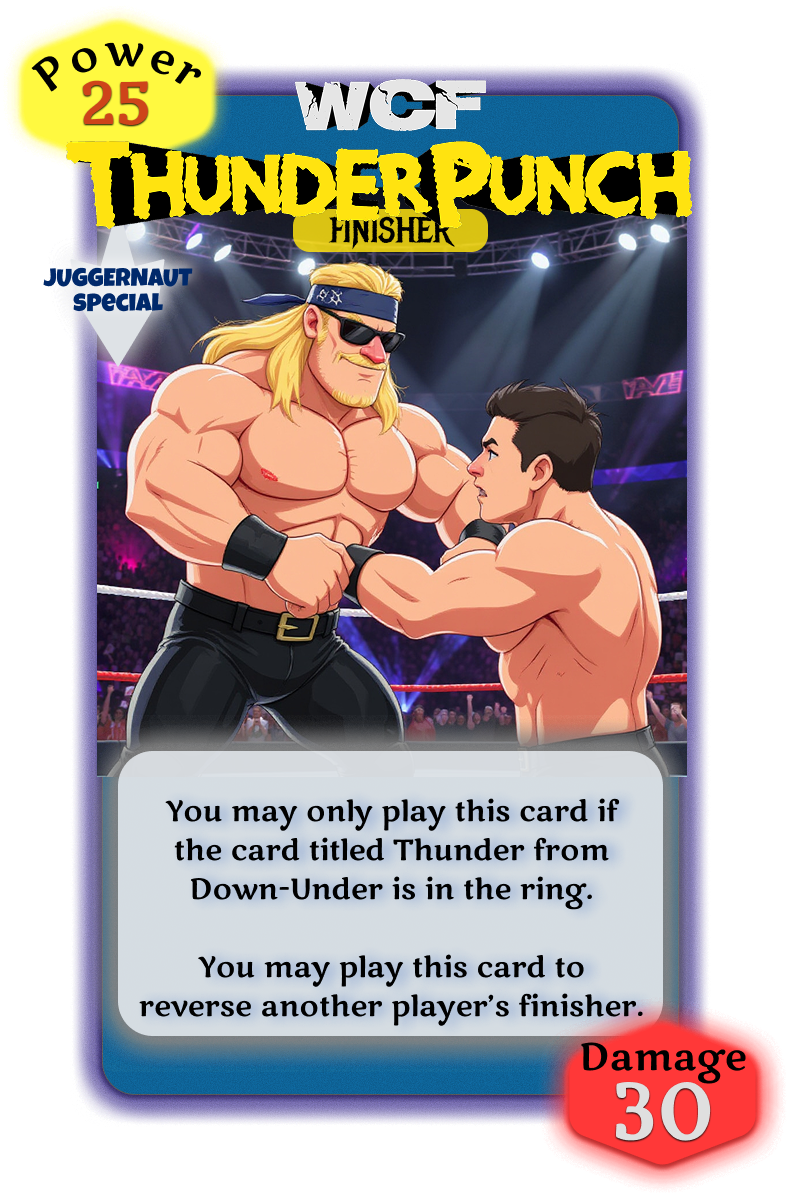
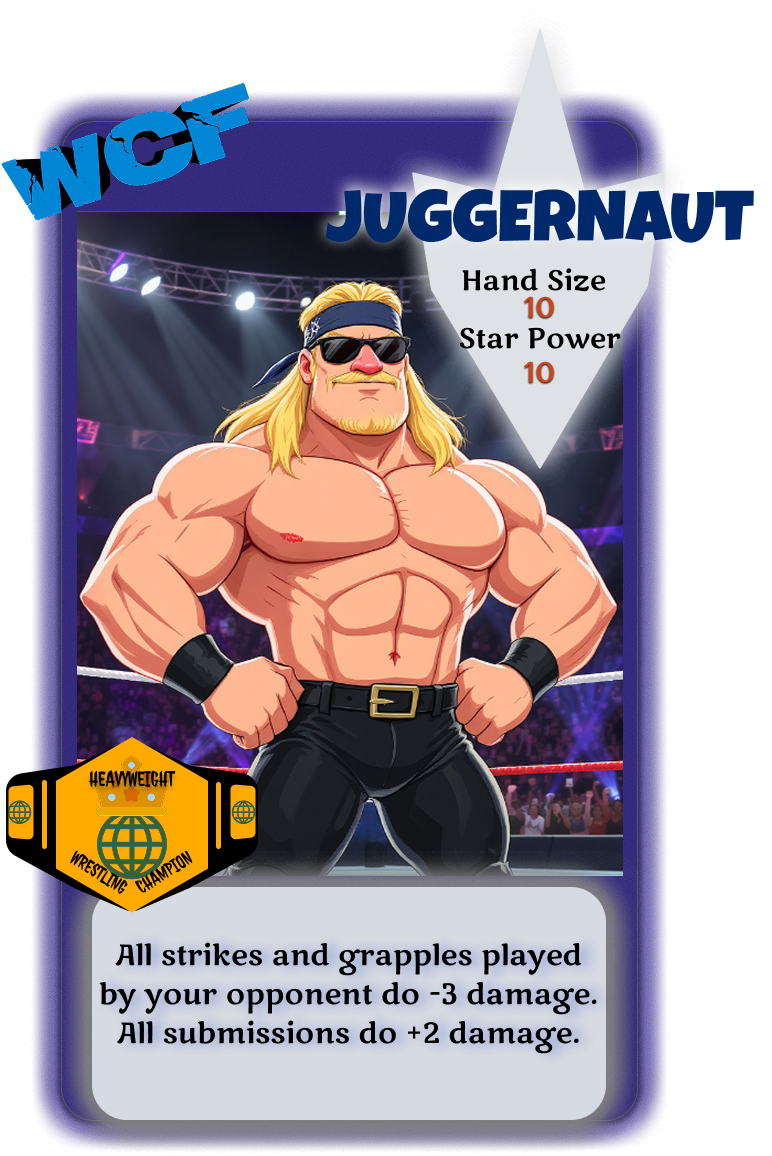
I am morally and ethically opposed to using generative AI when there are millions of artists looking for work, but I had literally no budget for an artist and had to do everything myself. AI was only used to create the images of the wrestler, nothing else. The good news for you is that I’m pretty good at using AI when I have to (please just hire an artist).
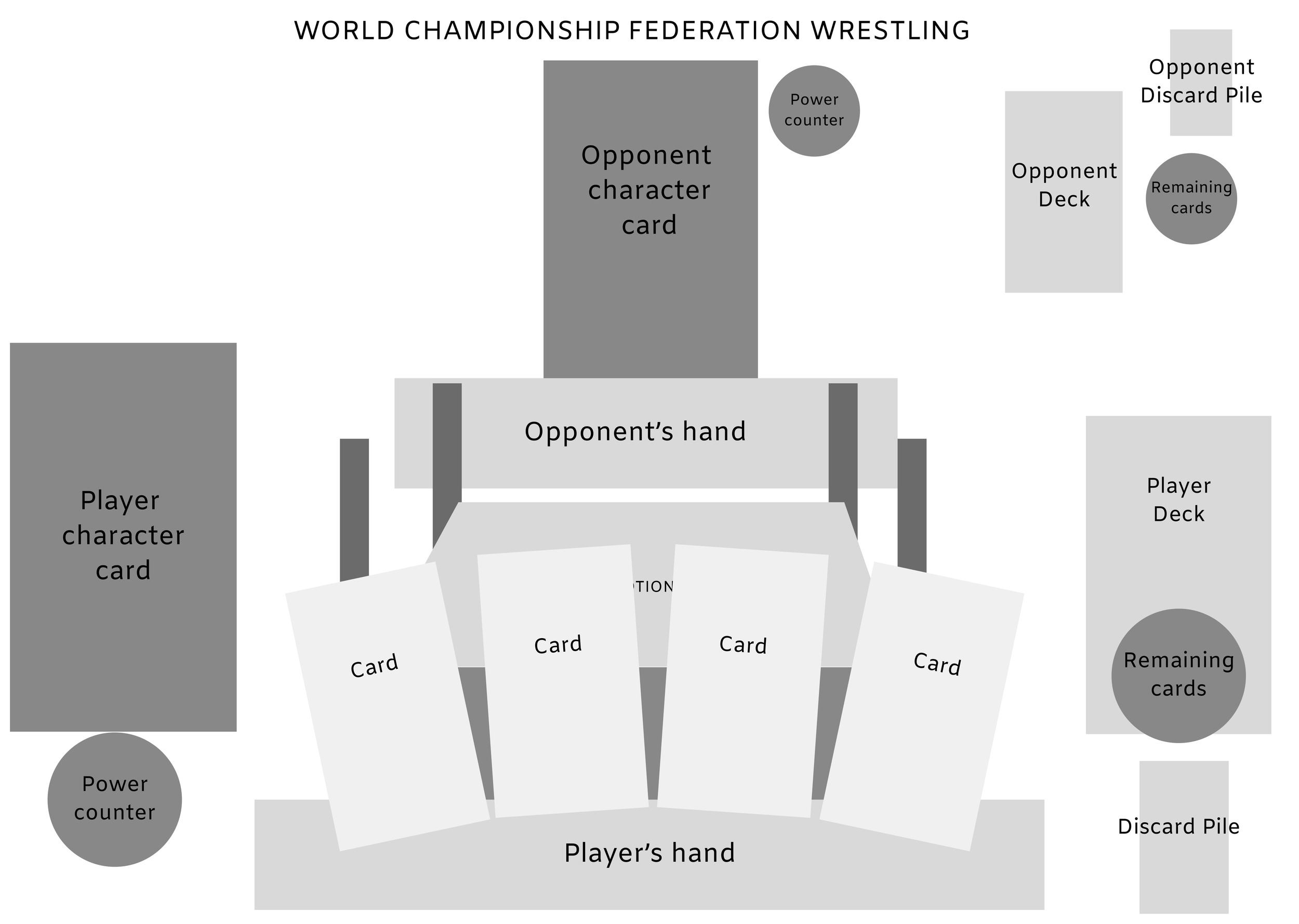
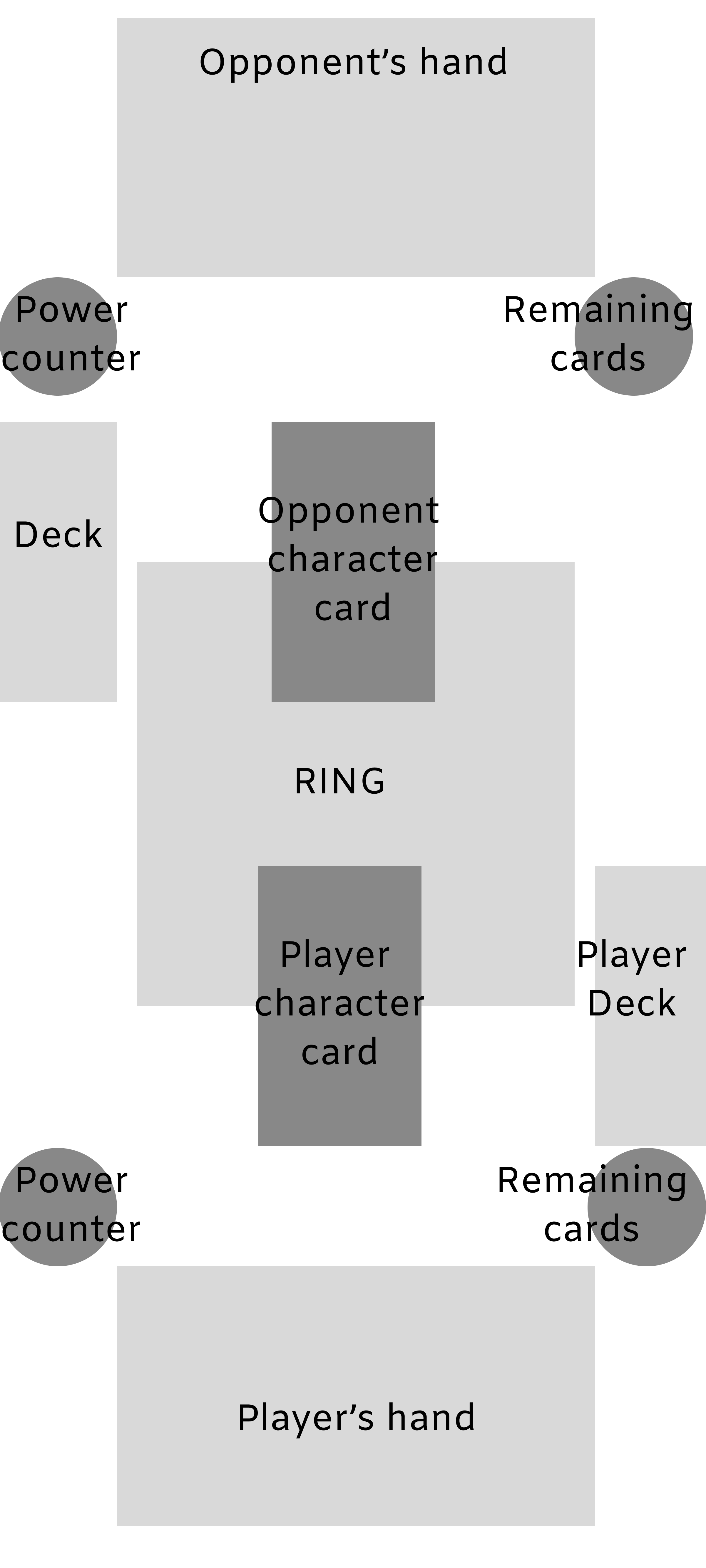
Early wireframes for the play screen on mobile and for console/PC (below).
The console/PC version was my attempt to argue for an isometric view to give it a more “wrestling” feel, since we would have a wider screen to work with.
Concept Art
“Blah, blah, blah. Revenue, mechanics - yeah, cool, but what did the game look like!?”
Alright, fair question.
I put together some wireframes and mid-fidelity mockups for star cards, special move cards, and the play field (what you would see while playing a match), all laid out below.
I can’t describe how much I enjoyed working on this project. It was, as I described it above, a confluence of lifelong passions to create the kind of game I always wanted to play.
I would love to speak with you about how I can put that passion to work on YOUR project. Use the form below to get in touch.